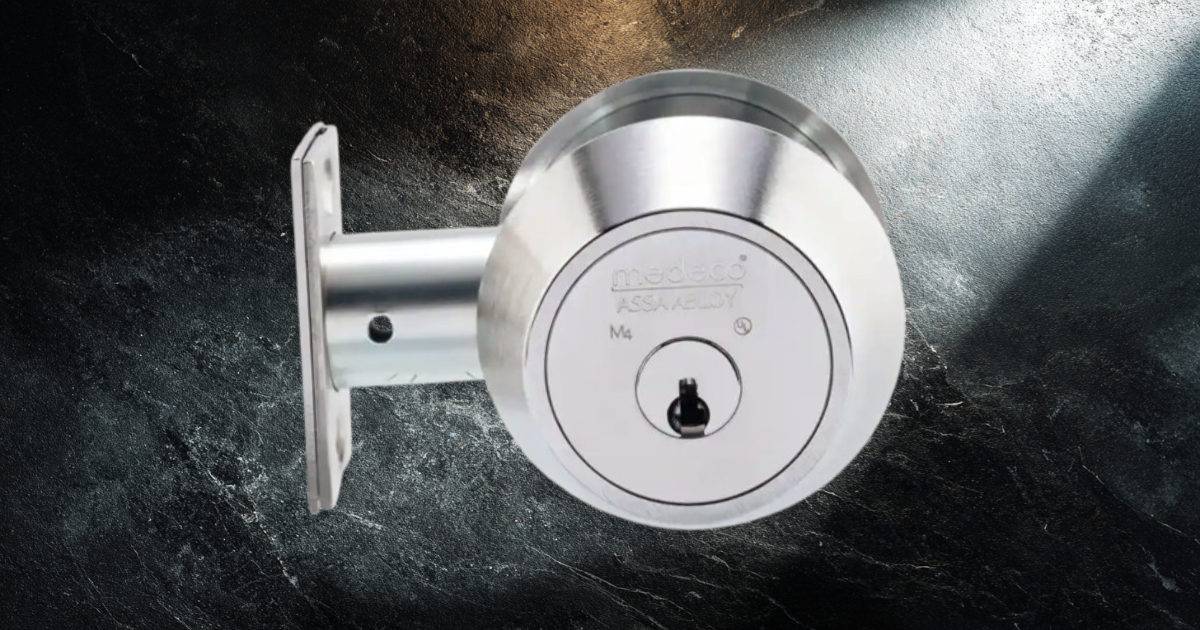
Here's a stat that changes how you think about door security: the vast majority of home break-ins happen through the front door. Not a window. Not a side entrance. The front door. And the most common method isn't lock picking — it's kicking. A solid boot to a standard deadbolt and door frame, and most residential setups fold in seconds. That's the threat model the Medeco Maxum was designed around, and it's the threat model where this lock absolutely dominates.
The Maxum isn't just a good deadbolt with a premium price tag. It's a completely different approach to what a residential deadbolt should be — engineered from the bolt outward to resist every attack method that actually gets used in the real world, and a few that only exist in a locksmith's testing lab.
The Physical Fortress
Let's start with what makes the Maxum special before we ever get to the cylinder. The bolt itself is 1" of hardened steel — that's a full-throw deadbolt that extends deep into the door frame. But the bolt is just the beginning. It sits inside a heavy-gauge tubular steel housing that wraps around the entire bolt mechanism. This housing is what makes the Maxum genuinely kick-resistant, because the force of a kick-in attack gets distributed across the steel tube instead of concentrating on the bolt alone.
Above the bolt, a steel shroud protects against "ice pick" attacks — where an attacker uses a thin tool to reach through the gap between door and frame to manipulate the bolt directly. The strike plate is a high-security design with a special box construction and 2" screws that anchor directly into the wall studs behind the frame. This is critical — most standard deadbolts come with 3/4" screws that only reach the door frame itself, which is often just a thin piece of pine. The Maxum's 2" screws go through the frame and into the structural wood behind it.
The exterior collar is solid brass and free-spinning, which means a wrench attack (gripping the outside of the lock and twisting) just spins the collar without transmitting any force to the mechanism. The 1/4" diameter mounting bolts resist prying and hammering. Every component is designed to handle a specific attack vector.
Most deadbolts resist picking reasonably well. The Maxum resists everything — kicking, prying, drilling, wrench attacks, crowbars, and picking. It's not just a cylinder with a bolt attached. It's a system.
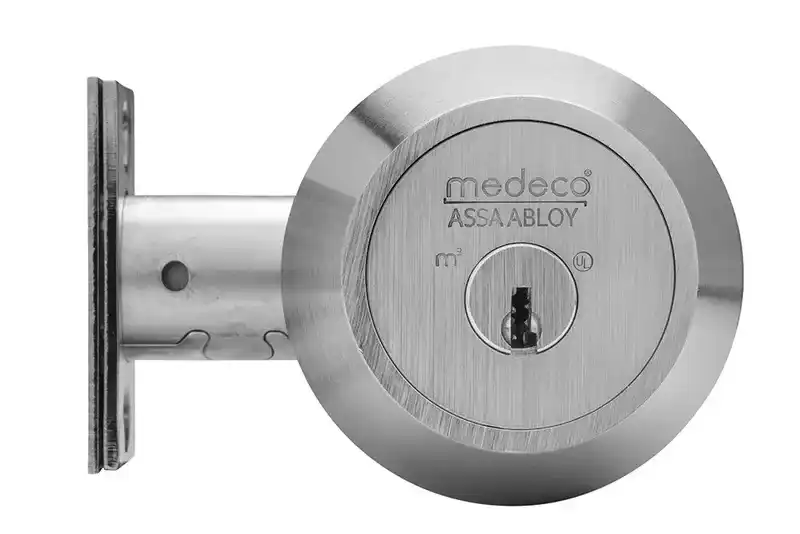
The high-security strike plate — box construction with 2" screws into the studs. This is where most kick-in resistance actually lives.
The Cylinder: Rotating Pins and the Sidebar
The Maxum is available with either the Medeco 3 (M3) or Medeco 4 (M4) cylinder platform. Both use Medeco's signature rotating pin technology — a system where each pin must not only be lifted to the correct height (like any pin tumbler) but also rotated to a specific angle. This means every pin has two independent variables a picker must solve simultaneously: height and rotation.
But that's not all. The pins also have to align a sidebar — a secondary locking element that prevents the plug from rotating even if all pins are set to the correct height. The sidebar engages with slots on the sides of each pin, and those slots only align when the pins are at both the correct height and the correct rotation angle. It's the same general concept as the Mul-T-Lock's locking bar, applied through Medeco's uniquely angled approach.
The M4 platform adds another layer: a movable element in the key itself that interacts with the cylinder in a way that can't be replicated by 3D printing or standard key cutting. This was specifically designed to address the emerging threat of key duplication through photographs — someone snaps a picture of your key, models it in CAD, and prints a working copy. The M4's movable element defeats this because it's not a static geometry that can be photographed and reproduced.
UL 437 Listed for pick and drill resistance. ANSI/BHMA Grade 1 certified. 6-pin cylinder with rotating pins and sidebar. 1" hardened steel bolt in tubular steel housing. Steel shroud against ice-pick attacks. Free-spinning brass collar defeats wrenching. High-security strike plate with 2" stud screws. Patented key control (M3 or M4). Bump proof. Available in single cylinder, double cylinder, and captive key configurations.
UL 437: What That Certification Actually Means
You see "Grade 1" on a lot of deadbolts — including the Schlage B60N, which costs a quarter of the Maxum's price. So what makes the Medeco different? The answer is UL 437.
ANSI Grade 1 is a durability and strength standard. It tells you the lock can withstand a certain number of cycles, a certain amount of force, and meets baseline security requirements. UL 437 is a security-specific listing that goes much further — it requires the lock to resist picking and drilling attacks under controlled laboratory conditions, with specific pass/fail criteria for each method. A lock can be Grade 1 without being UL 437. The Maxum is both.
In practical terms, this means the Maxum's hardened steel inserts have been independently verified to stop drill bits. The rotating pin cylinder has been tested against professional picking techniques. The bolt and housing have been evaluated against forced entry methods. This isn't marketing — it's third-party certification from Underwriters Laboratories, the same organization that certifies electrical safety for consumer products.
The Key Control Story
Medeco's key control is genuinely restrictive. The key blanks are patented — you can't buy them at a hardware store, and you can't get them from online key-cutting services. Duplication requires authorization through a Medeco dealer, and the M4 platform's movable element means even sophisticated unauthorized copying attempts (including 3D printing) won't produce a working key.
For homeowners, this means you know exactly how many copies of your key exist. That cleaning service doesn't get to make a secret copy. The previous tenant can't have duplicated the key before moving out. It's the same key control philosophy as the Mul-T-Lock MT5+ or the Abloy Protec2, applied to a deadbolt that's available through residential channels.
Expensive — $200–$350+ depending on configuration and finish. Keys can only be duplicated through Medeco dealers, which may not be nearby. Additional keys are not cheap. Only a 2-year warranty (Schlage offers lifetime). Overkill for low-risk neighborhoods where the door frame itself is the weakest link. Installation is straightforward but the lock is heavier than standard deadbolts. The security is only as good as the door and frame it's installed in — a Medeco on a hollow-core door is wasted money.
Medeco Maxum vs. Schlage B60N
This is the comparison most people want, and the answer depends entirely on your threat model.
| Category | Medeco Maxum | Schlage B60N |
|---|---|---|
| ANSI Grade | Grade 1 | Grade 1 |
| UL 437 | Yes — Listed | No |
| Pick Resistance | Exceptional (rotating pins + sidebar) | Good (anti-pick shield + pins) |
| Drill Resistance | Hardened steel inserts (UL verified) | Anti-drill plate |
| Kick Resistance | Tubular steel housing + 2" stud screws | Reinforced strike + 3" screws |
| Key Control | Patented — dealer authorization required | Standard SC1 — duplicated anywhere |
| Bump Resistance | Immune (rotating pins) | Yes |
| Price | $200–$350 | $35–$85 |
| Warranty | 2 years | Lifetime |
| NoPryZone Score | 9.3 / 10 | 7.5 / 10 |
If you live in a low-crime suburban neighborhood and your primary concern is "does my front door have a good deadbolt," the Schlage B60N at $40 is the right answer. It's Grade 1, it resists kicks reasonably well, and it's five times cheaper. But if you have a specific reason to need maximum security — high-crime area, high-value contents, a stalking or harassment situation, commercial property, or you just want the absolute best — the Maxum is in a different league entirely. The UL 437 listing, the rotating pins, the key control, and the tubular steel bolt housing are not things you can get from any other residential deadbolt at any price.
The Spec Sheet
| Category | Medeco Maxum |
|---|---|
| ANSI Grade | Grade 1 |
| UL Rating | UL 437 Listed |
| Cylinder | 6-pin rotating with sidebar (M3 or M4) |
| Bolt | 1" hardened steel in tubular steel housing |
| Pick Resistance | Exceptional |
| Drill Resistance | Hardened steel inserts (UL verified) |
| Bump Resistance | Immune |
| Key Control | Patented — M3 utility patent / M4 movable element |
| Strike Plate | Box design, 2" screws into studs |
| Anti-Wrench | Free-spinning brass collar |
| Configurations | Single, double, captive key |
| Origin | USA (Medeco / ASSA ABLOY) |
| Price | ~$200–$350+ |
| Warranty | 2 years |
| NoPryZone Score | 9.3 / 10 |
The Deadbolt That Addresses the Actual Threat
Most people think about lock security in terms of picking — can someone open this with a set of picks? The Medeco Maxum handles that with rotating pins and a sidebar that make conventional picking virtually impossible. But the real genius of the Maxum is everything else: the tubular steel bolt housing that absorbs kick-in force, the 2" stud screws that anchor the strike plate to the structure of your house, the steel shroud, the free-spinning collar, the hardened steel inserts.
The Maxum doesn't just resist one type of attack. It resists all of them, simultaneously, to a standard that's been independently verified by UL 437 testing. That's not something any other residential deadbolt can claim at any price.
Is it expensive? Yes. Is it overkill for most people? Probably. But if you need the best deadbolt you can put on a residential door, this is it. Consumer Reports agrees. UL agrees. And after spending time with one, we agree too.