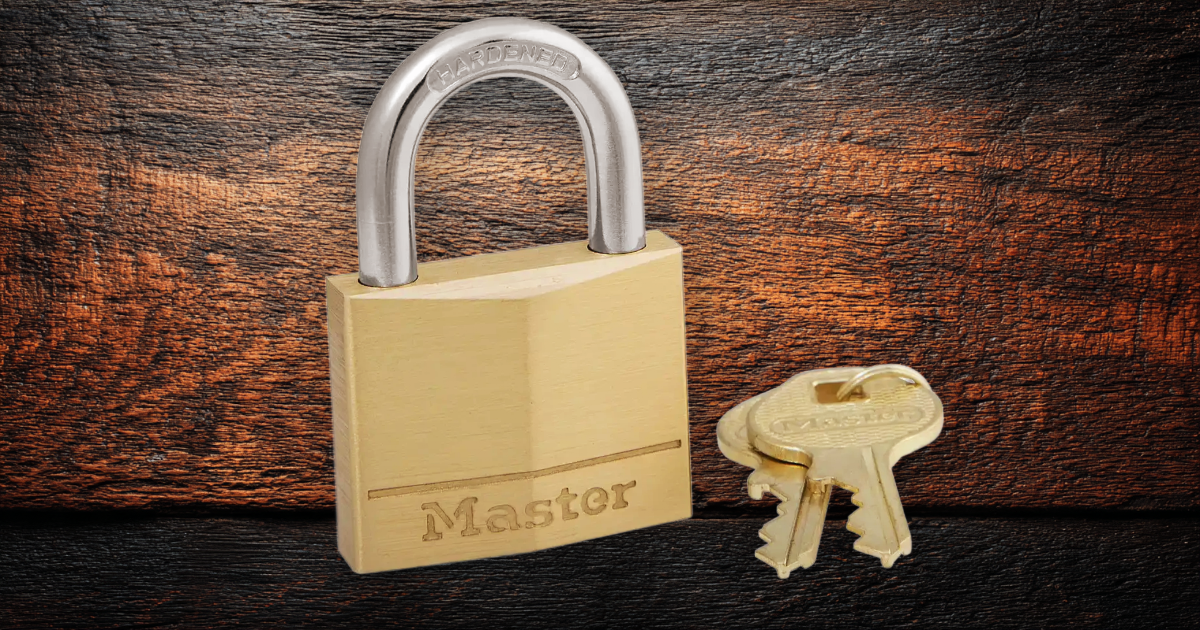
Master Lock is the most recognized padlock brand in North America. The 140D is one of their most popular models — a 40mm solid brass body with a hardened steel shackle, available at literally every hardware store, big-box retailer, and gas station in the country. It's also one of the most thoroughly defeated locks in the history of the locksport community, with thousands of videos documenting how quickly and easily it can be opened without a key. This review is going to explain why, and more importantly, what you should buy instead.
But first — fairness. The 140D is not the worst padlock you can buy. It's better than the Master Lock No. 3 (which we've covered), better than any combination lock, and better than the weird off-brand stuff you find in dollar store bins. It has a real cylinder, a hardened shackle, and a Limited Lifetime Warranty. The problem isn't that it's terrible. The problem is that it's barely adequate, it costs almost the same as locks that are significantly better, and Master Lock's marketing implies a level of security that the product simply does not deliver.
The Four-Pin Problem
The 140D uses a four-pin tumbler cylinder. Four pins. For context, the ABUS 55/40 — a lock that costs roughly the same — uses five. The American Lock 1100, a lock that costs about $10 more, uses five or six with multiple security pins. Four pins is the minimum that any serious manufacturer puts into a padlock, and even by that low bar, the 140D's execution is mediocre.
The manufacturing tolerances are loose. That's not speculation — it's documented by the locksport community and by Lockwiki, which specifically notes that the 140D's "poor manufacturing tolerances allows it to be easily picked by low skill attackers." The pins bind loosely. The feedback is sloppy. A picker with even basic skills can feel the shear line and set each pin without much resistance. It's the kind of lock where you sometimes get an accidental open just from inserting a rake and jiggling it around.
Master Lock claims the 4-pin cylinder "prevents picking." The locksport community has opened it on camera roughly ten thousand times. Someone is wrong here, and it's not the people with the picks.
The Comb Attack: The Real Problem
Picking is one thing — it at least requires some skill and a basic understanding of how locks work. The comb attack is something else entirely. It's a bypass technique that requires zero skill, takes about three seconds, and works on the 140D because of a fundamental design vulnerability.
A comb pick is a thin piece of metal with teeth that slide into the keyway and lift all the pin stacks simultaneously into the driver pin chambers above the shear line. Once every pin stack is pushed up past the shear line, the plug rotates freely. No tension wrench needed. No feeling for individual pins. No skill whatsoever. Insert the comb, push up, turn. Done.
This works on the 140D because the pin chambers have enough clearance above the shear line to accommodate the entire pin stack when pushed upward. It's a known vulnerability that's been documented for years. Some padlock designs prevent this by using tighter chamber tolerances or longer driver pins. The 140D does neither.
Only 4 pins — fewest in its price class. Loose tolerances exploitable by beginners. Vulnerable to comb/overlift attacks requiring zero skill. Security pin inclusion is inconsistent — some units have one spool, many have none. Easily raked in seconds. No anti-drill protection. Soft brass body. Thin 6mm shackle. No key control. Cannot be non-destructively disassembled. Master Lock markets it as "pick resistant" — the locksport community disagrees strongly.
What It Actually Does Okay
In fairness, the 140D isn't completely without merit. The solid brass body does resist corrosion well — it'll survive outdoor exposure better than a cheap laminated lock. The hardened steel shackle is a real hardened steel shackle, and the dual locking levers provide basic pry resistance. It's self-locking, it comes with two keys, and the Limited Lifetime Warranty means Master Lock will replace it if it fails mechanically.
For locksport, the 140D is actually a decent first practice lock. It's cheap enough to be disposable, widely available, and provides that Yellow Belt level challenge where you're learning to feel pins set. The older units with the spool pin in position 3 give beginners their first encounter with a false set, which is a valuable learning moment. If you're getting into picking and want something to practice on while you watch TV, the 140D earns its keep.
Solid brass body resists corrosion. Hardened steel shackle — real, not plated. Dual locking levers for basic pry resistance. Cheap and available everywhere. Decent beginner locksport practice lock. Lifetime warranty. Better than a combination lock or a warded padlock.
The $3 Upgrade That Changes Everything
Here's what kills us about the 140D: the ABUS 55/40 exists. It costs roughly $3 more. And it's better in every single measurable way — five pins instead of four, tighter tolerances, no comb vulnerability, better shackle plating, double-bolt locking instead of dual levers. For the price of a mediocre coffee you can upgrade from a lock the internet opens for fun to a lock that at least makes someone work for it.
We're not going to reprint the whole comparison here — we already did that in the ABUS 55/40 review. But if you're standing in a hardware store right now holding a 140D in one hand, put it down and walk to the ABUS section. You will spend three dollars more and get a meaningfully better product. That's the simplest upgrade in all of home security.
The Spec Sheet
| Category | Master Lock 140D |
|---|---|
| Mechanism | 4-pin tumbler |
| Body Material | Solid brass |
| Body Width | 40mm (1-9/16") |
| Shackle Material | Hardened steel |
| Shackle Diameter | 6mm (1/4") |
| Pick Resistance | Very low |
| Comb Attack | Vulnerable |
| Security Pins | Inconsistent — 0 or 1 spool |
| Cut Resistance | Basic |
| Key Control | None |
| Rekeyable | No |
| LPU Belt | Yellow |
| Origin | USA (Master Lock) |
| Price | ~$10–$15 |
| NoPryZone Score | 3.5 / 10 |
The Lock You Buy When You Don't Know Better
The Master Lock 140D is the padlock equivalent of a screen door — it suggests that access is controlled without actually controlling it. Four pins with loose tolerances, inconsistent security pin inclusion, and a documented comb bypass that requires no skill whatsoever. It'll keep a locker closed at the gym. It won't keep a determined person out of anything.
We're not saying Master Lock is a bad company. They make some genuinely good products — the American Lock 1100 series is solid, the Magnum line has its place, and their commercial offerings are respectable. But the 140D specifically is a lock that relies on brand recognition more than engineering, and the three-dollar gap between it and the ABUS 55/40 is the most impactful security upgrade per dollar we've ever reviewed.
If you already own one and it's on a gym locker, you're fine. If you're about to buy one for anything else, don't. Spend the extra three dollars. Your stuff will thank you.