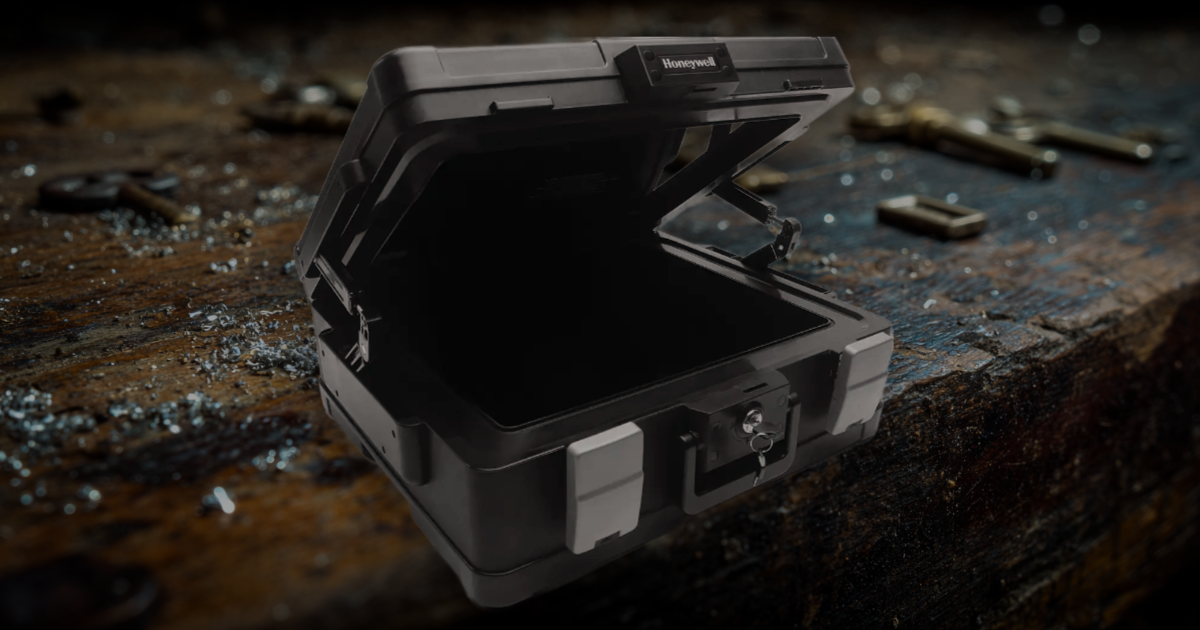
Here's a question most homeowners never ask until it's too late: if your house catches fire tonight, where are your birth certificates? Your property deed? Your marriage license? Your insurance policy? These documents aren't irreplaceable in a technical sense — you can reorder most of them — but rebuilding your identity paperwork after a house fire while simultaneously dealing with insurance claims, temporary housing, and emotional devastation is a special kind of bureaucratic hell that nobody should have to experience. The Honeywell 1114G exists to make sure you don't.
Let's be clear about what this product is and isn't: the 1114G is a fire and water chest. It protects documents from fire and flooding. It does not protect valuables from theft. The key lock provides privacy — roughly the level of security you'd get from a locked desk drawer. If someone steals this chest, the lock won't stop them from opening it. That's not a flaw; it's the design intent. This is disaster insurance, not burglary prevention.
The Fire Rating: What 60 Minutes Actually Means
The Honeywell 1114G carries an ETL certification for 60 minutes of fire protection at 1700°F. That's the external temperature — a fully involved residential fire. The certification means the interior stays below 350°F for the full 60 minutes, which is the temperature threshold at which paper begins to char. This is known as a UL 350 equivalent rating, and it's the standard for document-protecting fire chests.
Sixty minutes is the sweet spot for residential use. Most house fires are controlled within 30 to 45 minutes of the fire department arriving. A 60-minute rating gives your documents a meaningful buffer even if response time is slow. It's not infinite protection — if your house burns for two hours, the interior temperature will eventually exceed 350°F — but it covers the vast majority of real-world scenarios.
Important caveat: 350°F protects paper, but it can still damage electronics. USB drives, external hard drives, SD cards, and photo film can be affected at temperatures well below 350°F. If you're storing digital media, you need a UL 125 rated container (interior stays below 125°F), which the 1114G is not. For digital backups, use cloud storage or a media-rated fire safe.
The 1114G protects paper from fire and water. That's it. That's the product. If you understand this, it's one of the best values in document protection. If you expect it to stop a thief, you've bought the wrong thing.
The Water Rating: 100 Hours at 1 Meter
This is where the Honeywell stands out from cheaper competitors. The 1114G is ETL-certified for 100 hours of waterproof protection at 1 meter of depth. That means full submersion — not splashing, not sprinkler spray, but sitting at the bottom of a flooded basement for over four days. The compression latches create a seal that the SentrySafe H0100 can't match, and the heavy-duty double-wall construction gives the chest structural integrity under water pressure.
The waterproof rating matters more than most people realize. House fires create water damage too — from fire hoses, burst pipes, and sprinkler systems. A fire chest that survives the flames but lets water in has failed at its one job. The 1114G's 100-hour rating means your documents survive both the fire and the firefighting.
One real-world note: despite the waterproof rating, moisture can accumulate inside over time from humidity. Seasoned owners recommend throwing a couple of silica gel packets inside and opening the chest to air it out every few weeks. This isn't a design flaw — it's basic maintenance for any sealed container.
ETL-certified 60-minute fire protection at 1700°F. ETL-certified 100-hour waterproof at 1 meter depth. Interior fits legal-size documents flat (14.8" × 12" interior). Heavy-duty double-wall insulated construction (not hollow). Compression latches for waterproof seal. Safety-rated load-bearing hinges. Carry handle for portability. Two privacy keys included. 42 lbs — heavy enough to feel serious. 0.39 cu. ft. capacity. Lifetime after-fire replacement guarantee.
The Limitations
The key lock is a privacy lock. It uses a standard tubular key mechanism that provides minimal security against someone who actually wants to get in. This is fine — the 1114G is not marketed as a burglary-resistant safe, and Honeywell doesn't pretend otherwise. But some buyers expect a key lock to mean "secure," and it doesn't. If you need theft protection, you need a different product.
There's no bolt-down capability. At 42 lbs, the 1114G is heavy enough that it won't blow away in a tornado, but it's light enough for someone to carry out of your house. Again — this is a fire chest, not a security safe. If you want something that's both fire-rated and anchored, look at the SentrySafe SFW205GQC (which has bolt-down hardware) or the Gardall MS912.
The 0.39 cu. ft. interior fits legal-size documents flat, which is a genuine advantage over the smaller SentrySafe H0100 (which can't even fit standard letter-size paper flat). But it's still just a chest — you won't fit a laptop, large photo albums, or significant bulk inside. Think of it as: one folder of critical documents, a couple of passports, a few USB drives, and maybe a small jewelry pouch.
Privacy key lock only — zero theft deterrence. No bolt-down capability — can be carried away. Not rated for electronics or digital media (UL 350, not UL 125). Interior is shallow (3.8" height) — no room for tall items. Moisture can accumulate inside without periodic airing. Not a safe — no pry resistance, no security bolts, no steel construction. Heavy enough to be awkward (42 lbs) but not heavy enough to stay put.
What Belongs in a Fire Chest
The 1114G is purpose-built for a specific category of items: documents you need in the aftermath of a disaster. Birth certificates, Social Security cards, passports, property deeds, vehicle titles, insurance policies, medical records, wills, and powers of attorney. If you'd need it to file an insurance claim, prove your identity, or restart your financial life, it goes in the chest.
What doesn't belong: jewelry (use a burglary-rated safe), cash over a few hundred dollars (same), firearms (use a gun safe), irreplaceable photos (use cloud backups or a media-rated safe), and electronics (UL 125 rated chest required). The 1114G protects paper from fire and water. Keep it focused on that job.
The Spec Sheet
| Category | Honeywell 1114G |
|---|---|
| Fire Rating | ETL 60 min at 1700°F |
| Water Rating | ETL 100 hours at 1m depth |
| Capacity | 0.39 cu. ft. |
| Interior | 3.8" H × 14.8" W × 12" D |
| Exterior | 7.3" H × 20" W × 17.2" D |
| Weight | ~42 lbs |
| Lock Type | Privacy key lock |
| Construction | Heavy-duty insulated double-wall |
| Bolt-Down | No |
| Fits Legal-Size | Yes — flat |
| Warranty | Lifetime after-fire replacement |
| Price | ~$60–$90 |
| NoPryZone Score | 6.0 / 10 |
The Best Fire Chest for the Money — If You Know It's a Fire Chest
The Honeywell 1114G does one thing and does it well: it keeps paper documents safe from fire and water. The 60-minute fire rating covers the vast majority of residential fires. The 100-hour waterproof rating is best-in-class for this price range. The interior fits legal-size documents flat, which the cheaper SentrySafe H0100 can't manage. And the lifetime after-fire replacement guarantee means Honeywell literally replaces it for free if it survives a fire.
It's not a safe. The key lock is privacy-level. There's no bolt-down. A motivated thief could carry it out under one arm. None of that matters if you understand the product category. At $60–$90, the 1114G is disaster insurance for the price of a nice dinner. Toss your critical documents in, throw in some silica gel packets, and put it somewhere unlikely to be the first thing that burns. Your future self — the one standing in front of a smoldering house trying to remember where the insurance policy is — will thank you.